UK Address Matcher

Fast, simple address matching (geocoding) in Python.
Why use this library
- Simple. Setup in seconds, runs on a laptop. No separate infrastructure of services needed.
- Fast. Match 100,000 addresses in ~30 seconds.1
- Proven accuracy. We use public, labelled datasets to measure and document accuracy.
- [OPTIONAL] Support for Ordnance Survey data. We provide an automated build pipeline for users wishing to match to Ordnance Survey data. Matching to any other canonical dataset is also supported.
The end-to-end process of matching 100,000 addresses to Ordnance Survey data, including all software downloads and data processing takes:2
- Less than a minute if you are matching to a small area such as a local council region.
- If matching to the whole UK, there's a one-time preprocessing step that takes around 10 minutes. Subsequent matching of 100k records takes less than a minute.
Installation
pip install uk_address_matcher
What does it do?
uk_address_matcher finds the best known address for each address in your dataset.
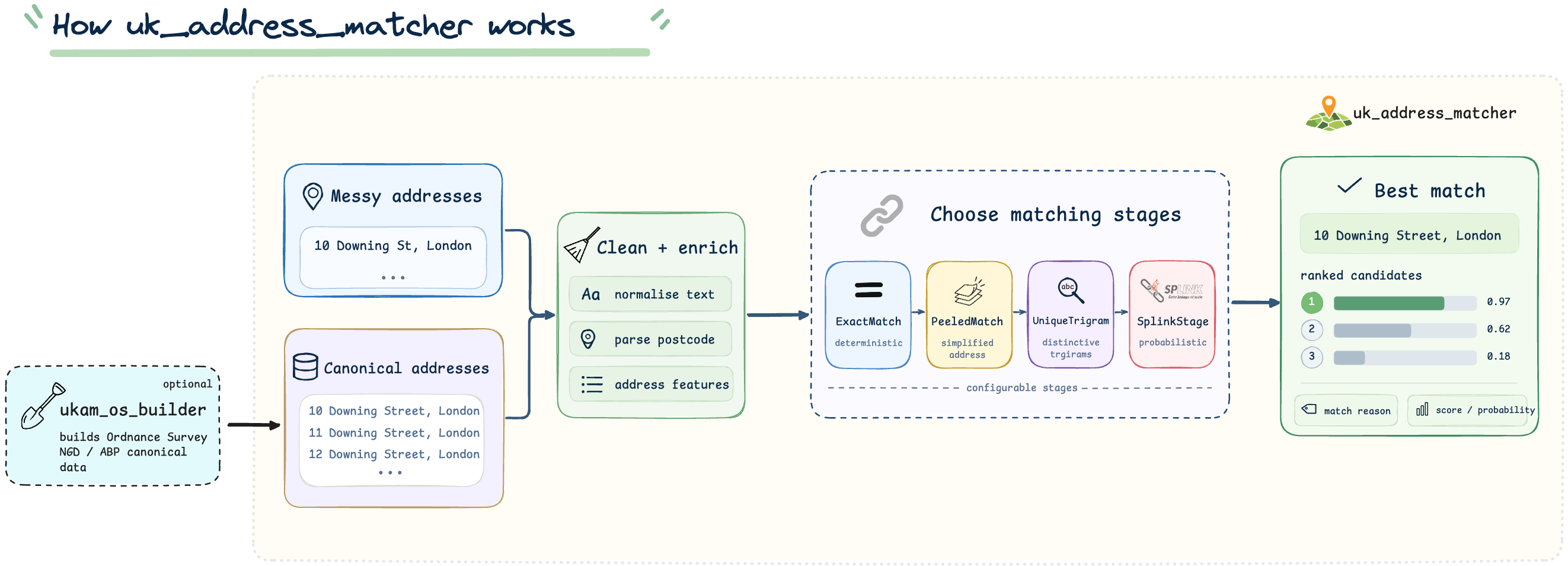
- [OPTIONAL]: Construct Ordnance Survey canonical data using ukam_os_builder. Skip this step if you already have a canonical dataset or are using another source.
- Input: provide a messy dataset, such as addresses typed by users, and a canonical dataset of known addresses. See the input data requirements.
- Preparation: addresses are cleaned, standardised, and enriched with useful features such as postcodes. See the canonical dataset preprocessing guidance.
- Matching: configurable matching stages compare each messy address with candidate canonical addresses, from exact matches through to probabilistic matching with Splink. See choosing a matching threshold.
- Output: the best match, together with the match reason, match weight, and distinguishability score. The threshold guide explains how to interpret these scores.
Example:
Your data should be in the following format3:
Messy data
| unique_id | address_concat | postcode |
|---|---|---|
| m_1 | Flat A Example Court, 10 Demo Road, Townton | AB1 2BC |
| ...more rows |
Canonical data
| unique_id | address_concat | postcode |
|---|---|---|
| c_1 | Flat A, 10 Demo Road, Townton | AB1 2BC |
| c_2 | Flat B, 10 Demo Road, Townton | AB1 2BC |
| c_3 | Basement Flat, 10 Demo Road, Townton | AB1 2BC |
| ...more rows |
You can match it as follows:
import duckdb
from uk_address_matcher import AddressMatcher

con = duckdb.connect()
messy = con.read_csv("example_data/messy_example.csv")
canonical = con.read_csv("example_data/canonical_example.csv")

matcher = AddressMatcher(
    canonical_addresses=canonical,
    addresses_to_match=messy,
    con=con,
)
result = matcher.match()
result.matches().show(max_width=10000)
Example output:
| unique_id | resolved_canonical_id | original_address_concat | original_address_concat_canonical | match_reason | match_weight | distinguishability |
|---|---|---|---|---|---|---|
| m_1 | c_2 | Flat A Example Court, 10 Demo Road, Townton | Flat A, 10 Demo Road, Townton | splink: probabilistic match | 13.5885 | 11.5033 |
The above is recommended if your canonical dataset is relatively small, say, under 1 million rows. If you're matching to larger canonical dataset, a preprocessing step is recommended. See choose whether to pre-process your canonical dataset for details.
Use Cases
Here is a list of some of our known users and their use cases:
- The Greater London Authority's High Streets Data Service uses the
uk_address_matcherto precisely geolocate London's businesses and assign each of them a commercial UPRN, in order to fully map the city's retail provision and commercial property use. - Homes England has tested the Splink-based address matcher to link the Land Registry Price Paid dataset with the Ordnance Survey National Geographic Database (NGD). In a Databricks environment, it links around 30 million records in under five hours with high accuracy, helping to identify and monitor new builds that contribute to the 1.5 million homes mandate.
- The Welsh Government's DataMapWales team is using the
uk_address_matcherto build a central, self-service address matching service in FME Flow. It matches free-text addresses, including Welsh language and bilingual addresses, against Ordnance Survey NGD, attaches UPRNs, and provides confidence ratings and review flags. By providing a simple user interface for the technical matching process, the service will make address matching capabilities accessible to teams without specialist coding or data engineering expertise.
Licence
This project is free and open source and is released under the MIT licence.
Next steps
- Overview
- Getting started
- Choosing a matching threshold
- Optimising accuracy
- Working with Ordnance Survey data
- Performance and benchmarking
- API reference
-
Timings on a MacBook Pro M4 Max. ↩
-
Does not include the time taken to download Ordnance Survey data since this depends on the speed of your internet connection. ↩
-
The
postcodecolumn is optional. If you include it, the matcher will use it directly. If you do not, the matcher will attempt to detect and extract postcodes fromaddress_concat.uk_address_matcheralso supports matching addresses that lack a postcode. ↩